May 28, 2026
12 min read
Umbrella Brand Strategy: How to unify sub-brands without losing your identity?
Share this article

Picture this. Your company has just announced an acquisition. The press release is planned, the deal is signed, and someone in the leadership meeting says: “We’ll just put our logo on it and align the colors. How hard can it be?”
Six months later, your customers are confused about what you actually do. Your acquired brand’s best salespeople have left. And your parent brand, once sharp and distinctive, now feels like it’s trying to be everything to everyone.
The reality of mergers and acquisitions is brutally pragmatic. Between 70% and 90% of M&A deals fail to meet their financial expectations, according to Harvard Business Review study. While dealmakers spend months auditing financial spreadsheets and operational supply chains, they routinely treat brand architecture as an afterthought – a visual detail to be figured out months after the closing dinner. That delay is where deal value goes to die.
When you acquire a company, you’re not just buying its physical assets or IP. You’re buying its brand equity – the trust, market recognition, and customer loyalty it has built over years. Brand equity accounts for 59% of corporate value globally, according to NielsenIQ. During a merger, this value is highly volatile. An umbrella brand strategy, designed before the deal closes, is what protects it.
An umbrella brand strategy lets you expand into new markets, absorb acquisitions, and launch new products without starting from scratch every time. But wielded carelessly, it does the opposite: it dilutes what made your brand strong, creates internal confusion, and sends mixed signals to the very customers you’re trying to win.
This article is for leaders and brand managers who are about to make – or are in the middle of making – a structural brand decision.
An umbrella brand strategy is a brand architecture model where a single master brand covers multiple products, services, or divisions. Everything that lives under the umbrella inherits the parent brand’s equity, trust, and recognition. When you launch something new, you’re not starting from scratch – you’re borrowing credibility.
The classic examples are everywhere. FedEx runs FedEx Express, FedEx Ground, and FedEx Freight – all distinct services, all instantly recognizable as FedEx. Virgin sells flights, cruises, financial products, and broadband under the same bold red identity. Apple puts iPhones, MacBooks, and Apple Watches under one roof without anyone questioning whether they belong together.
But here’s where most people get confused: an umbrella brand is not the same as a house of brands.
The endorsed model sits between the two extremes – the sub-brand has its own identity, but the parent endorses it visibly.
Because companies routinely start building without deciding which model they’re in. They design a logo, write brand guidelines, and only then realize their sub-brand structure doesn’t match their governance capacity or their market reality. The model you choose determines everything that follows: how you manage assets, how you communicate externally, how you allocate budget, and how much freedom your divisions actually have.
Without defined boundaries between sub-brands, you trigger a quiet but expensive set of problems. It rarely announces itself dramatically – it builds gradually.
Yes – if you haven’t defined their market boundaries before the merger closes. When two companies with overlapping portfolios are brought together under an ambiguous corporate message, they stop competing with the market and start competing with each other. Same keywords. Same buyer personas. Same events. The budget doubles. The results don’t.
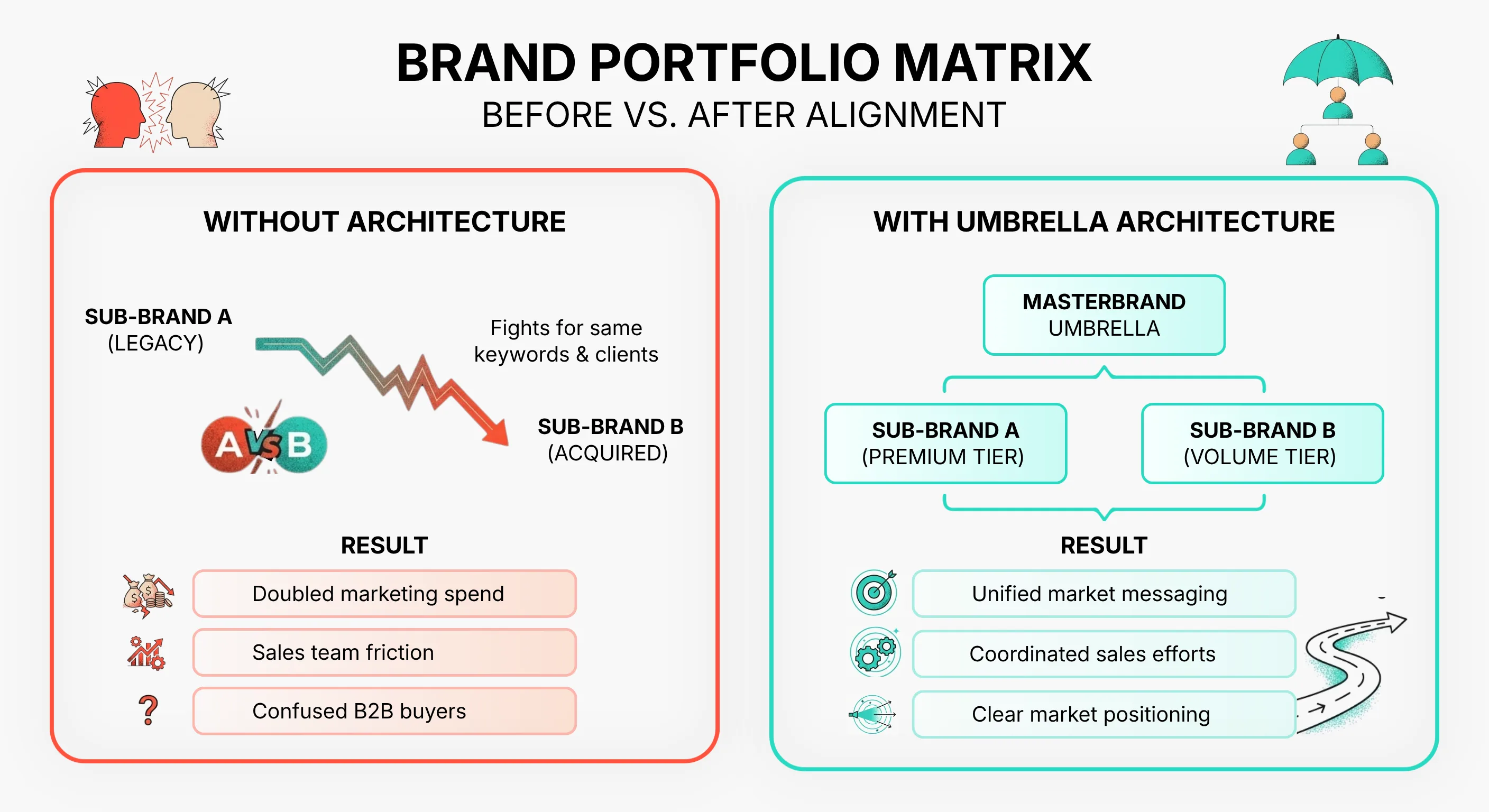
The left side of this picture is more common than most companies admit. Without a defined architecture, Sub-brand A (legacy) and Sub-brand B (acquired) don’t complement each other – they compete.
The right side shows what a structured umbrella architecture actually delivers. The masterbrand sits above both sub-brands – one as a premium tier, one as a volume tier – with clear positioning for each. The result is unified market messaging, coordinated sales efforts, and clear market positioning that the whole organization can execute consistently.
If you aggressively erase an acquired brand’s identity overnight, you alienate its loyal customer base and hand them to your competitors. If you keep it completely independent with no structural link to the parent, you fail to transfer its reputational trust upward. Neither extreme works. The architecture is what makes the middle path possible.
And the financial stakes are real. A 2025 McKinsey analysis found that organizations managing integration effectively are more than 40% more likely to meet their cost synergy targets and up to 70% more likely to hit revenue targets. Brand architecture is a core part of that integration, not a footnote to it.
Knowing which model fits your situation on paper is one thing. Seeing how real organizations have navigated it is another. Below are three scenarios we’ve worked on directly – each one a different version of the same fundamental challenge: how do you stay recognizably one thing, while letting each entity be fully itself?
When Accelleron separated from ABB’s turbocharging division in 2022, they faced a challenge that’s deceptively simple to describe and genuinely difficult to execute: become an independent brand, from scratch, without losing the credibility built over nearly a century inside someone else’s identity.
The umbrella question here is almost inverted. The parent brand (ABB) was stepping back, not forward. Accelleron needed to establish its own umbrella – its own visual identity, governance system, and market positioning – while operating in an industry where trust is everything and unfamiliarity is a red flag.
What the umbrella strategy had to solve: build enough parent brand strength fast enough that Accelleron’s product lines and regional operations could shelter under it coherently – not under ABB’s legacy, not under a transitional hybrid, but under something genuinely new and credible.
What Admind built was not just a visual identity. It was a brand operating system – governance rules, a central brand portal, templates, and rollout infrastructure across digital, physical, and internal environments – so that from day one, Accelleron looked credible and complete as a standalone company. Read the full Accelleron case study →
The umbrella lesson: When you’re building a new parent brand from scratch, the governance infrastructure matters as much as the logo. A brand that can’t be consistently executed across markets isn’t a brand – it’s a concept.
When ABB acquired ASTI Mobile Robotics, they didn’t acquire a small, anonymous company. They acquired a brand with its own market positioning, customer relationships, and identity – one that meant something to the people who worked there and the clients who chose them.
The umbrella question here is about how much of the acquired identity you preserve while achieving consistency under the parent brand. Move too fast, and you destroy the equity you paid for. Move too slowly, and you end up with a confusing hybrid that satisfies nobody.
What the umbrella strategy had to solve: integrate ASTI’s visual identity, digital presence, and communication assets into ABB’s global brand system – while protecting customer trust and operational continuity during the transition.
The answer was a phased integration framework: clear governance defined what was fixed (ABB standards) and what was flexible (ASTI’s positioning in robotics), with a structured migration timeline that gave every market a clear path from legacy to aligned. Read the full ASTI case study →
The umbrella lesson: Bringing an acquired brand under your umbrella is not a rebrand. It’s a migration. The distinction matters – a rebrand implies you’re creating something new. A migration implies you’re moving something valuable from one place to another without dropping it.
B&R Industrial Automation joined the ABB Group in 2017. B&R was not a small acquisition – it was a world leader in industrial automation with nearly four decades of market history and a deeply loyal customer base. Its brand equity was real, specific, and fragile in the way that specialist brands always are: strip away what makes it distinct and you’re left with nothing worth having.
The umbrella question here is the most nuanced of the three: how do you align a strong sub-brand with a stronger parent brand without flattening it?
This is the tension at the heart of every umbrella brand strategy. The parent brand wants consistency. The sub-brand wants to retain the specificity that built its reputation. Both are right. The job of brand strategy is to find the architecture where both can be true simultaneously.
What the umbrella strategy had to solve: standardize B&R’s identity across global markets to meet ABB’s governance requirements – while preserving the industrial automation positioning that made B&R worth acquiring in the first place.
Admind developed a phased transition framework where global standards were non-negotiable (visual alignment, governance processes, approval structures), but regional execution toolkits gave local teams the flexibility to maintain B&R’s communication style in markets where its reputation was strongest. Read the full B&R case study →
The umbrella lesson: The goal is not uniformity. It’s coherence. Uniformity means everything looks the same. Coherence means everything makes sense together – even when it looks different.
Three scenarios. Three different answers. But they all share one question that comes before any of them: does your brand have the right to go where you’re taking it?
This is what brand strategists call brand permission – a concept rooted in Kevin Lane Keller’s research on brand equity and brand extensions (Keller, 1993). It describes how far a brand can stretch into new territory before consumers stop believing it. It’s not about what you want to do. It’s about what your audience will accept.
Perceived fit is whether the new territory feels like a logical extension of what your brand already stands for. Nike moving into fitness equipment feels natural – the brand lives in athletic performance. But in 1988, Nike acquired Cole Haan – a formal footwear and accessories brand in an attempt to stretch beyond athletic performance. After 24 years, the business was generating losses and pulling resources away from Nike’s core. In 2012, Nike sold Cole Haan to refocus on brands that were complementary to their identity. It wasn’t a dramatic collapse – but it was a clear signal that formal footwear simply didn’t belong under the same umbrella as athletic performance.
Brand strength is how much equity you’ve built up. A brand with enormous trust and recognition can stretch further than a younger, less established one. Apple launching a credit card in 2019 is a good example – consumers accepted it, with Goldman Sachs calling it the most successful credit card launch ever. The brand’s equity around premium design and seamless experience transferred to a financial product. Whether it was a lasting business success is a separate question – but the brand permission was clearly there.
The risk for companies planning acquisitions or divisions is different though. The question isn’t just can our brand cover this new thing? It’s: can our brand cover this new thing without making everything else feel less coherent? An umbrella that stretches too far doesn’t just fail in the new territory – it weakens the whole structure underneath.
Before bringing a new entity under your umbrella, run through these three:
Surprising is fine. Surprising means it’s unexpected but it makes sense once you think about it. Bizarre means there’s no logical connection. If you need to write three paragraphs explaining why this fits your brand, it probably doesn’t.
Colors and logos can be aligned in weeks. Values take years to build. If the acquired company or new division operates on fundamentally different principles, putting your brand on it is a liability, not an asset.
An umbrella brand is only as strong as its weakest touchpoint. If the new entity can’t meet your quality and consistency standards in product, communication, and experience – your parent brand absorbs that gap.
If you answer confidently to all three, your brand has permission to stretch. If any answer gives you pause, that’s the signal to slow down and decide whether you’re looking at an umbrella play – or a house of brands situation where independence is actually the smarter move.
Most articles about umbrella brand strategy focus on the challenge of bringing things under the umbrella. Few talk about what happens to the umbrella itself when it’s carrying too much.
Brand overextension is real, and it’s quiet. It doesn’t announce itself with a failed product launch. It creeps in as a gradual loss of clarity – the parent brand starts meaning slightly less to each new audience it meets, until one day it means something different to everyone and something specific to no one.
The most significant structural risk is shared reputational vulnerability. Because every sub-brand shares the same visual identity and corporate name, a product failure, regulatory issue, or reputational crisis within one sub-brand can damage the entire portfolio. This isn’t a reason to avoid the umbrella model – it’s a reason to govern it seriously.
The warning signs that your umbrella brand is under strain:
That last one is particularly telling. When governance documents grow to accommodate every new exception, it’s a sign that the architecture is under stress – not that the guidelines need more pages.
Strategy without measurement is belief. Here are the thing and signals worth tracking.
These are harder to quantify but easier to spot if you’re looking:
That last point matters more than any metric. Governance without ownership is a policy document, not a system. Every sub-brand under your umbrella needs a named person or team accountable for how it uses the parent brand.
Remember the meeting we described at the beginning? “We’ll just put our logo on it. How hard can it be?” The companies that ask that question aren’t being careless – they’re just solving the wrong problem. Brand architecture isn’t a design task you schedule after the deal closes. It’s a strategic decision you make before the deal is signed.
We’ve worked with global organizations across industrial, financial, and technology sectors, and the pattern is consistent. The companies that treat umbrella brand strategy as a strategic input, not a design output, protect more of what they build. They retain the talent they acquire, maintain the trust they’ve earned, and extend their brand into new territory without leaving a trail of confusion behind them.
Not sure where your brand architecture stands today? We offer a free consultation, and then we can help you map your current structure, identify the gaps, and outline what a well-governed umbrella brand system could look like for your organization.