May 19, 2026
11 min read
Branding for banking – how financial institutions build trust at scale
Share this article

In an industry where the product is largely invisible, a financial institution’s brand is its most tangible asset. However, finance remains one of the least branded industries in the world, and this presents a significant opportunity.
In financial services, brand is the product. Money is abstract, investment strategies are complex and the difference between one private bank and another is rarely apparent at first glance. Yet people entrust their life savings, inheritance and business assets, their most intimate financial reserves, to institutions they may never visit in person and whose staff they will rarely meet.
What makes that possible? Trust. In financial services, trust does not come from product specifications or interest rate tables. It comes from the accumulated weight of every interaction a client has ever had with the institution, including every email, report and digital touchpoint, as well as every moment of clarity or confusion.
In this sector, brand communicates one thing above all else: “Can I trust you with what matters most to me?”
This question forms the basis of every branding decision in finance. This is why financial services branding is one of the most constrained creative disciplines and also one of the most consequential.
Swiss financial brands stand out because the country itself acts as a guarantor of their quality. It has spent centuries reinforcing a set of values associated with the country: precision, reliability, discretion and a focus on the long term. When a private bank has an address in Zurich, it inherits a reputational halo that cannot be fully replicated by any advertising budget.
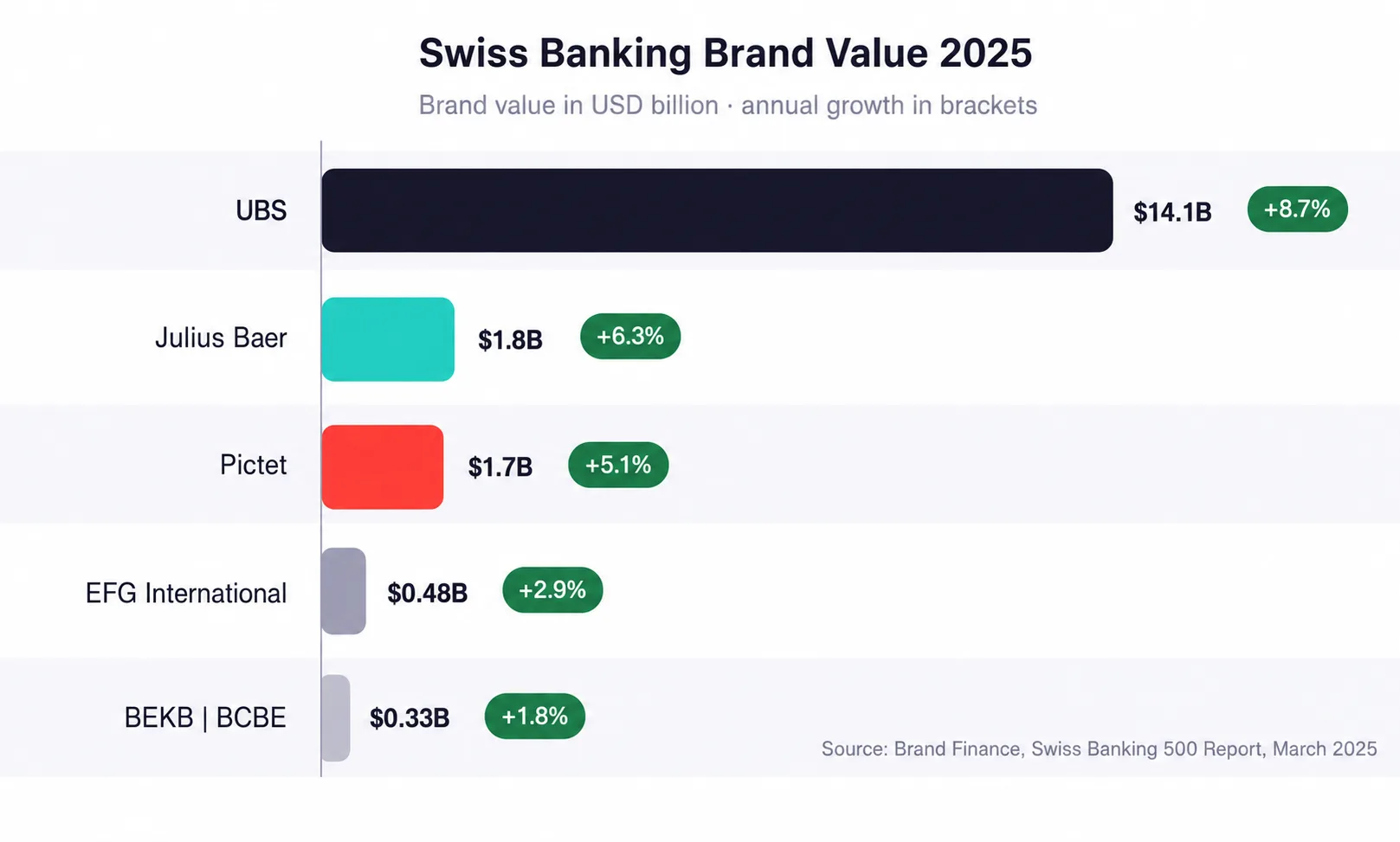
This translates into something commercially extraordinary: a presumption of competence by default. Switzerland is home to UBS, Julius Baer, Lombard Odier and Pictet, each of which has spent decades building an identity that is simultaneously rooted in heritage and responsive to the present.
These are not vanity metrics. Brand value on this scale translates directly into client acquisition costs, pricing power and resilience during market stress. Institutions with the strongest brand foundations proved to be the most resilient in the face of reputational pressure and able to retain client confidence.
Most financial brands still appear safe and conservative, and, frankly, forgettable. The reasons for this are structural, and understanding them is the first step to overcoming them.
The demographics of ultra-high-net-worth individuals (UHNWIs) are changing. Younger inheritors of wealth are digital natives who have higher expectations regarding visual sophistication, transparency and values alignment. New entrants, such as fintech challengers and neo-banks, are rewriting the rules by taking a brand-first approach.
When institutions merge on a large scale, brand becomes the cultural glue that holds the combined organisation together. We have witnessed this firsthand, and aligning two global banking identities under a single coherent system is as challenging as any operational integration.
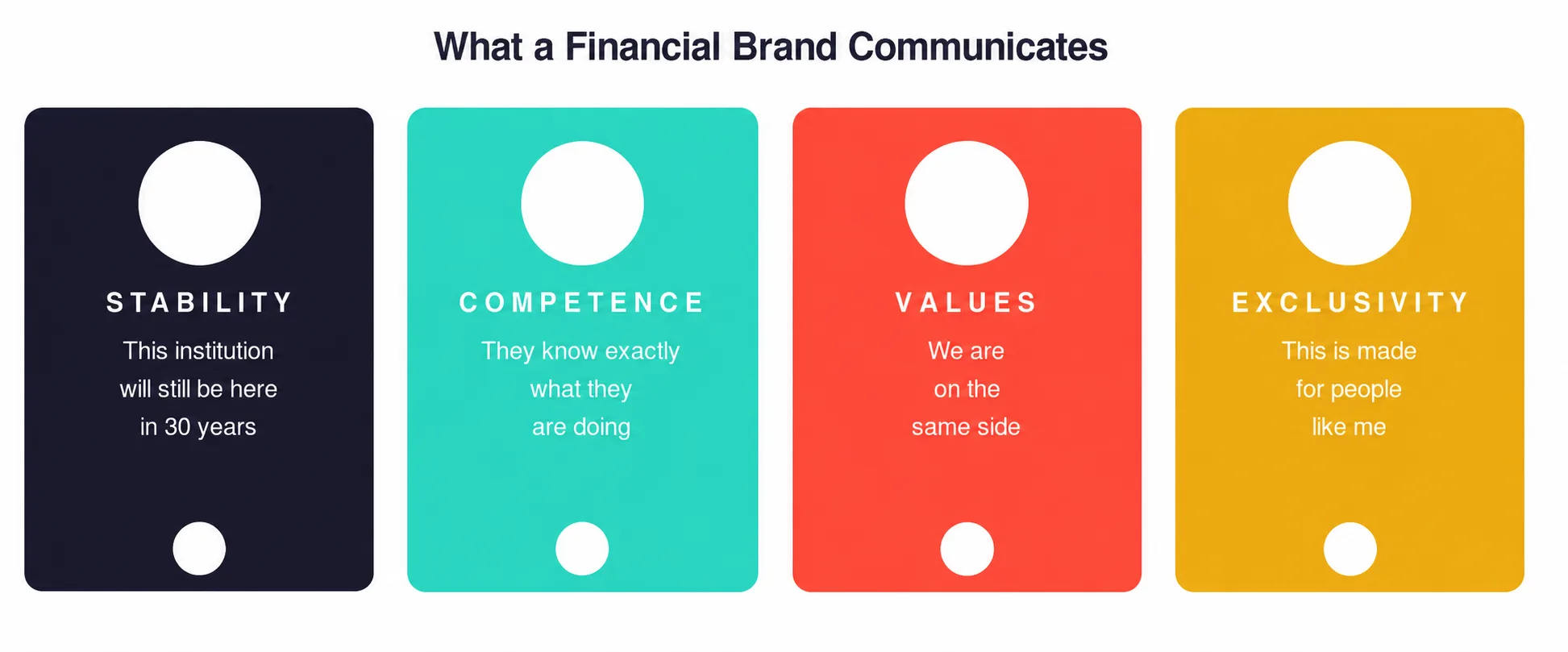
Financial brands communicate four things, in order of importance: stability, competence, values and exclusivity.
Each of these speaks to a different aspect of client psychology.
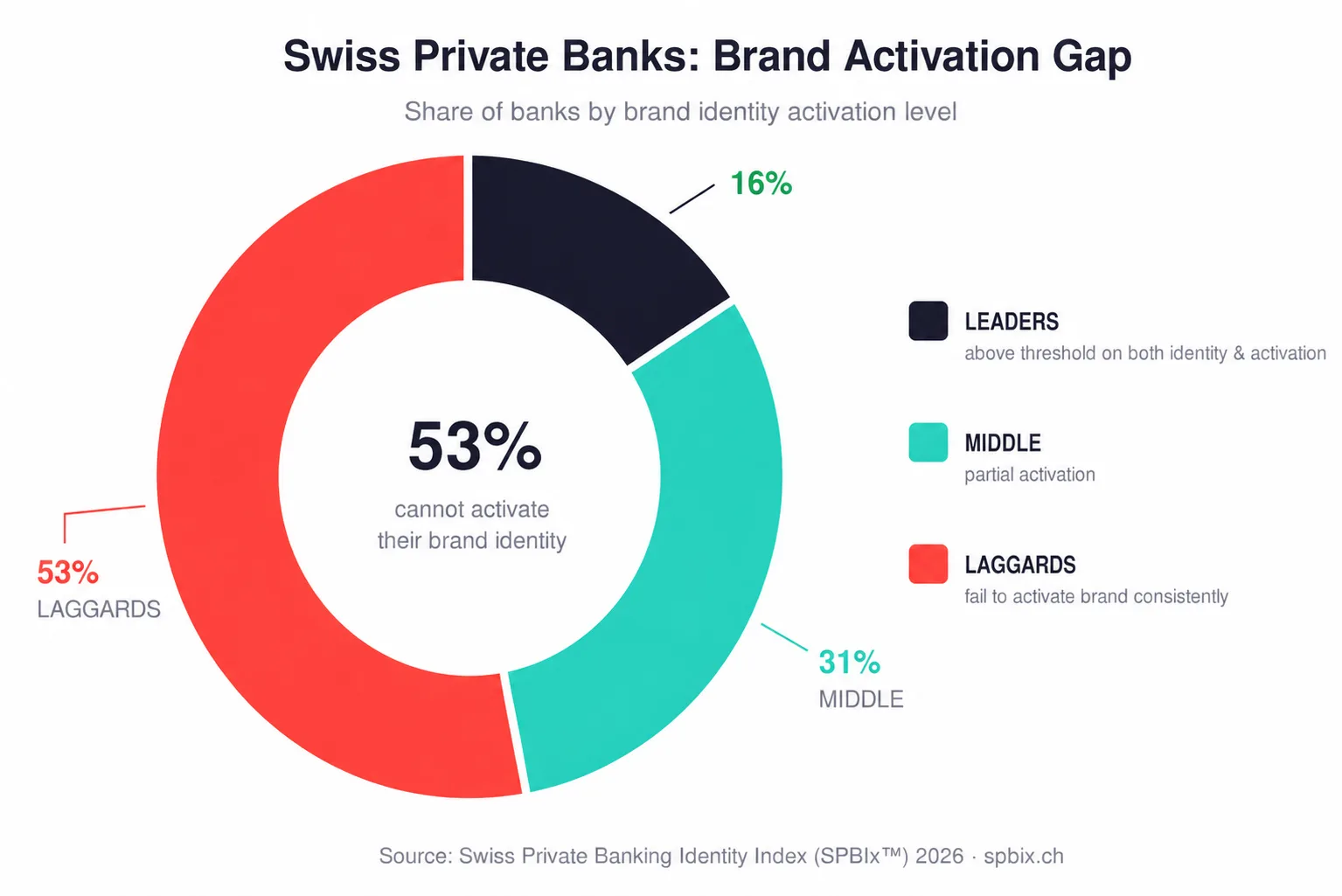
Research from the Swiss Private Banking Identity Index confirms this: many institutions articulate elements of brand identity, but too often fail to activate them consistently.
“Brand is still treated by many financial institutions as a communication topic rather than a management discipline.” — Swiss Private Banking Identity Index
The practical implication is that if a client receives a beautifully designed annual report, but then gets an email with a broken template and an incorrect font, the brand contract is broken. Every inconsistency erodes trust a little more.
The answer is not better guidelines; it is a brand operating system (brandOS). Ensuring brand consistency for large financial institutions operating in multiple markets is not a design issue, but a systems problem.
Consider what brand consistency actually requires in practice. A client report produced in Singapore should look and feel the same as one produced in Zurich. A social media post from the Warsaw office should use the same visual language as one from London. A junior banker in Geneva should use the same tone and typographic conventions as a senior private banker in Dubai when composing a proposal.
This cannot be achieved through PDF brand manuals alone. Style documents become outdated within months. The solution is systemic: brand rules should be embedded in the tools people actually use; there should be governed templates for every use case; and asset repositories should make the correct choice the easiest choice.
Photo by Sean Pollock on Unsplash
When industrial giant, ABB needed to reposition itself as a digital innovation leader across more than 100 markets, we co-created its new visual and verbal identity, including the ABB Brand Portal, a centralised governance platform providing teams worldwide with access to templates, illustration systems and brand guidelines. This enables consistent execution on a global scale without the need for constant agency intervention.
For UBS, we developed the visual identity system for their ‘Always-On’ digital campaign targeting high net worth individuals in the UK, creating a consistent design language for social media and display ads that conveys trust, sophistication and personalised wealth planning.
It is the wrong question. The most successful financial rebrands reject the binary entirely. Heritage and innovation are not opposites, but sequential arguments. ‘Heritage’ says, ‘We have been here long enough to know what we are doing.’ Innovation says, ‘But we are still learning.’
Julius Baer is a useful case study. Founded in 1890, the bank has spent over 130 years building a reputation for discretion, expertise, and personalised service. Its brand positioning, anchored in the idea of ‘Passion to Perform’, does not celebrate heritage for its own sake, but uses it as evidence of sustained commitment.
Following its acquisition of Credit Suisse in 2023, UBS was confronted with an even more challenging situation. The task was to unify the two historically distinct organisations, which together employ over 100,000 people, behind a single brand following the most significant event in Swiss banking in a generation. The chosen positioning line, ‘Banking is our craft’, reframes heritage as vocation. It is not ‘We have been here for 160 years’. It is ‘We have spent 160 years becoming experts in this field.’
“The most sophisticated financial rebrands do not choose between heritage and innovation. They reframe heritage as the proof point for future reliability.”
The practical question is not whether to modernise, but by how much and in which direction. Brand equity built up over decades should be treated as a strategic asset to be developed, not a constraint to be disregarded.
Two perspectives on financial brand modernisation:
Digital transformation has created a new category of brand challenge that did not exist fifteen years ago: how to convey intangible values such as trust, exclusivity and stability on a screen.
For industries that have built their identities through physical spaces, such as marble lobbies, heavy doors and the weight of paper statements, the transition to digital-first interaction requires rethinking every brand touchpoint. Trust, which is communicated effortlessly through architecture and materiality, is more difficult to convey in a mobile interface.
Institutions that navigate this successfully have invested in what we call digital brand coherence: the systematic extension of brand standards to every digital touchpoint, including mobile apps, email signatures, automated investment reports, client portals and digital statements. This is not just a design exercise, but a governance infrastructure.
The challenge is further compounded by volume. Today, a financial institution produces more branded content in a week than it did in a year twenty years ago. Without systematic governance in the form of design systems, component libraries and approved asset repositories, entropy is inevitable. Entropy in brand communication is perceived by clients, consciously or not, as institutional instability.
AI-generated content and personalised reporting are accelerating this process. The number of touchpoints is growing exponentially. Financial brands that fail to build scalable governance systems now will be managing brand chaos within five years.
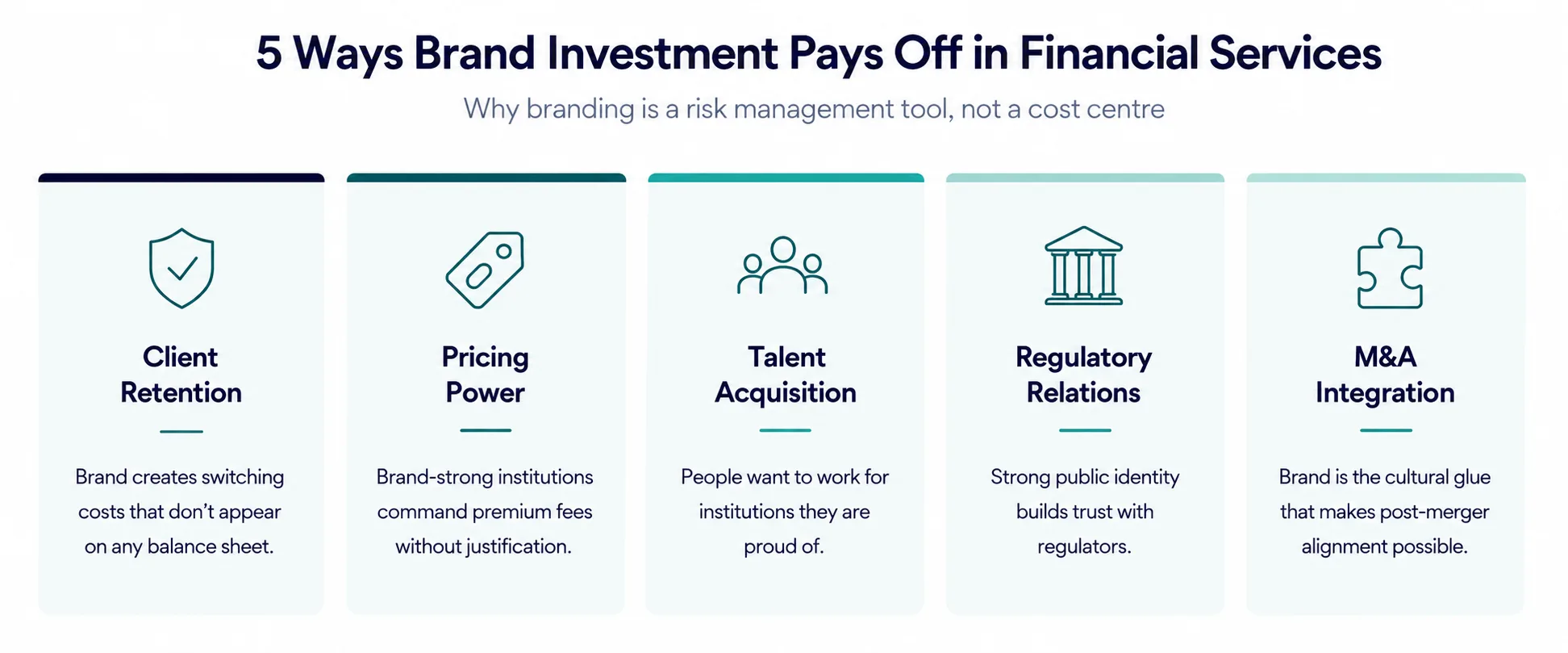
Strong financial brands consistently outperform weak ones, both in terms of brand metrics and commercial results. For leadership teams that still view branding as a cost centre, however, the evidence consistently points in the opposite direction.
Client retention: A strong brand creates switching costs that do not appear on any balance sheet. When clients have a deep, identity-level relationship with an institution, the probability of them switching during market turbulence drops significantly.
The 2025 Swiss banking data illustrates this concretely: despite turbulence in the sector, Swiss banking brands demonstrated resilient value growth. Investing in a brand is not a luxury reserved for good times. It is a risk management tool.
UBS’s choice of the word ‘craft’ as the centrepiece of its new brand positioning is fitting. ‘Craft’ implies skill, attention to detail, patience, and a commitment to doing things properly, even when taking shortcuts would be easier.
These are the qualities that the best financial brands embody. They demonstrate not just competence, but the kind of competence that stems from sustained investment in people, systems, and standards. It is the kind of competence that clients sense before they can articulate why they trust you.
Building and maintaining that brand is an ongoing process. It requires the same long-term thinking that the best financial institutions apply to client portfolios, and it demands ongoing discipline. It requires scalable brand systems, evolving visual identities, and communication architectures that can accommodate change without becoming fragmented.
Getting this right systematically, consistently and at scale is not just good marketing. It is good banking.
If you are navigating a rebrand, market expansion or the challenge of maintaining brand consistency across a complex organisation, we would love to talk. We have direct experience of working with financial institutions and Swiss global corporations, and we develop long-lasting brand operating systems.
Sources: